Tracking Carbs for Prediabetes: A Practical Starting Guide
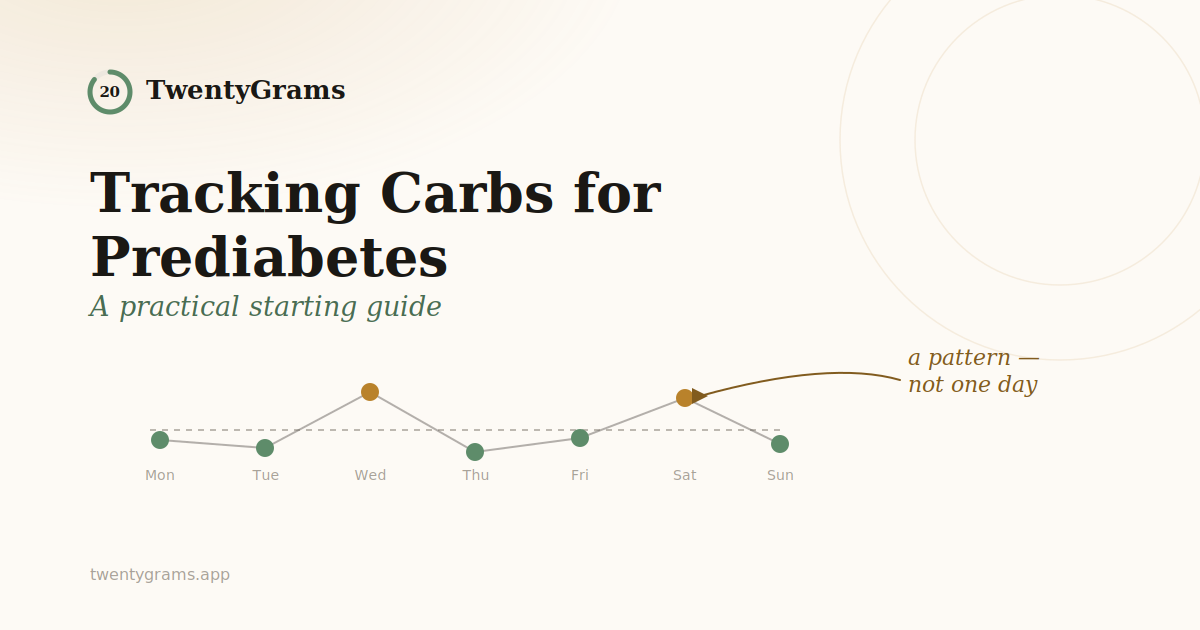
If a doctor or a recent lab result has you paying closer attention to carbs, you’re not alone — and you don’t need a medical background to start tracking in a way that’s actually useful. This is a starting guide for the tracking itself: what to record, why net carbs are the number worth watching, and how to turn a week of logs into something worth bringing to your next appointment.
This isn’t medical advice, and it’s not a substitute for your doctor’s guidance — it’s a practical guide to the tracking habit itself, which is the part most people are never actually taught.
Why net carbs, specifically
Total carbohydrate and net carbs are different numbers, and the difference matters more here than almost anywhere else. Fiber passes through your digestive system without being broken down into glucose, so it doesn’t affect the same things sugars and starches do. Net carbs — total carbs minus fiber — is a closer read on what actually reaches your bloodstream as sugar.
Net carbs = Total carbs − Fiber
A food can look carb-heavy on the label and still be a reasonable choice once you account for fiber. A cup of raspberries lists around 15g total carbs, but 8g of that is fiber — 7g net, per USDA FoodData Central. That distinction is the whole reason “just count carbs” advice is often too blunt to be useful day to day. (If you want the full breakdown, our net carbs guide covers the formula in more depth.)
What’s actually worth tracking
You don’t need to track everything to get something useful out of this. A short, honest list beats an elaborate one you abandon after four days.
Net carbs per meal, not just per day. A day total tells you less than you’d think — two very different eating patterns can land on the same daily number. Per-meal tracking shows when carbs are concentrated, which is the more actionable pattern to notice.
What the food actually was, in enough detail to be useful later. “Sandwich” tells you less than “turkey sandwich, whole wheat, no chips.” You’re not writing a food diary for style — you’re building a record specific enough that a pattern (or your doctor) can actually use it.
Timing, loosely. Morning, midday, evening is usually enough resolution. Exact-to-the-minute timestamps rarely add anything a general time-of-day note doesn’t already capture.
How you felt, only if something stood out. Unusual fatigue, a headache, feeling unusually hungry soon after eating — these are worth a one-line note next to the meal, not a full symptom journal. The goal is catching a pattern over weeks, not diagnosing a single day.
A realistic first week
Don’t aim for perfect logging on day one. Aim for logging something at every meal, even roughly, for seven days straight. A rough week of real data beats three perfect days followed by giving up.
If a full week feels like too much, start with just tracking net carbs at dinner — the meal most people eat most consistently — for two weeks, then expand from there once the habit is actually sticking.
Turning a week of logs into something useful
The value of tracking isn’t the log itself — it’s what a week or two of it lets you (or your doctor) actually see. A few things worth looking for once you have real data:
- Which meals or times of day tend to carry the most carbs
- Whether weekday and weekend patterns look meaningfully different
- Any recurring pairing between a specific food and how you felt afterward
None of this replaces lab work or a clinical conversation — it’s context that makes that conversation more concrete. Bringing an actual week of data to an appointment, instead of trying to remember what you ate, changes the kind of questions you can ask and get real answers to.
What to bring to your doctor
If you’re tracking specifically because of a doctor’s recommendation, the most useful thing you can bring back isn’t a summary in your head — it’s the actual log. A printable or exportable version of a week or two of net-carb entries, meal by meal, is far more useful than “I’ve mostly been eating low-carb.” Specifics let a doctor spot patterns you might not think to mention.
TwentyGrams is building a doctor-ready export for exactly this — a clean, factual record of what you logged and when, meant to be handed over as-is rather than interpreted by the app. No scores, no verdicts, just the data.
Starting simple
You don’t need a perfect system to start. You need a number you trust (net carbs, not total carbs), a habit you can actually keep for a week, and a record specific enough to be useful later — to you or to your doctor. Everything else can be refined once the habit exists.
That trustworthy number is the part TwentyGrams is built around: every food is matched against the USDA database, and net carbs come straight from verified total-carb and fiber values — no estimating, no rounding in anyone’s favor. Log by search or plain-text description, and the record is there whenever you need to look back at it.