Net Carbs, Explained
Net Carbs vs. Total Carbs: The Only Formula You Need
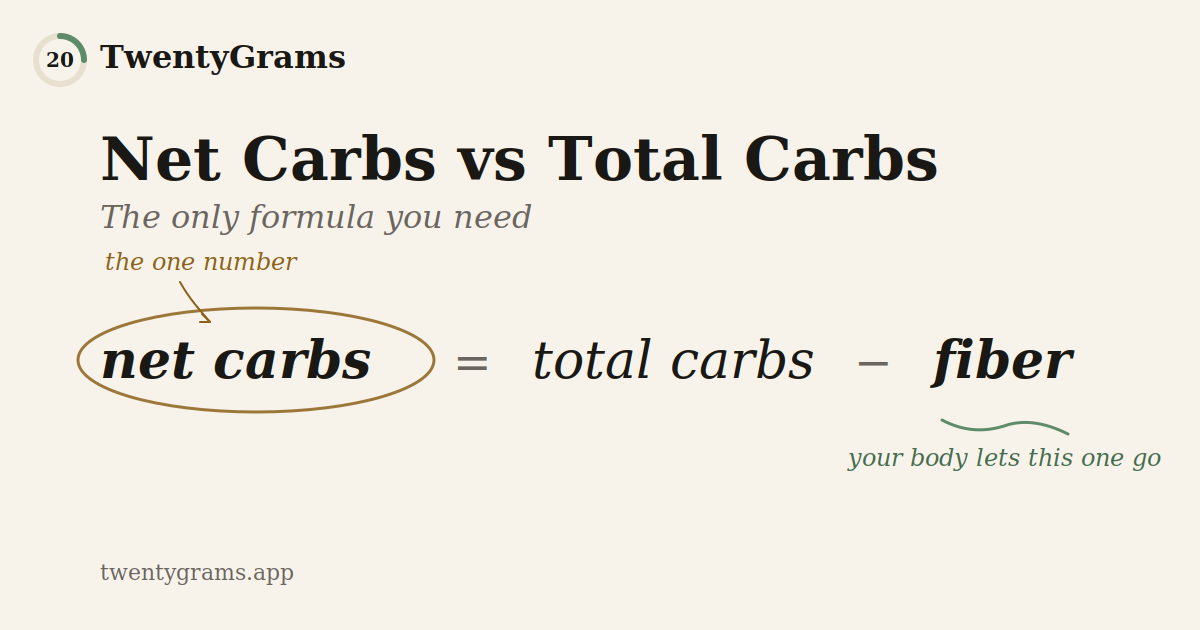
What’s the net carbs formula?
Net carbs = Total carbs − Fiber
That’s it. That’s the whole formula. If a nutrition label lists 12g total carbs and 5g fiber, the net carb count is 7g.
Some trackers also subtract sugar alcohols (erythritol, xylitol, and similar), since most of them don’t raise blood sugar the way regular carbs do. If a product lists sugar alcohols separately, the fuller formula is:
Net carbs = Total carbs − Fiber − Sugar alcohols
Erythritol is usually subtracted in full since it’s barely absorbed by the body at all. Maltitol is the one exception worth knowing — it behaves more like a regular carb than the others, so some trackers only subtract it partially, or not at all. If a label lists maltitol specifically, it’s worth counting it more conservatively than other sugar alcohols.
In TwentyGrams specifically, this second step is automatic and fixed — not a setting anyone picks. Erythritol and allulose are deducted in full (100%); every other or unrecorded sugar-alcohol type is deducted at 50%. That’s the whole rule, applied the same way for every user, every time — no picker, no alternate protocol to choose between.
That deduction only shows up on a food once a sugar-alcohol figure has actually been recorded for it — either from the source data it was matched against, or a one-tap correction on that specific food. Most foods in the database currently show no sugar-alcohol deduction simply because nobody has entered a figure for that food yet, not because the food is free of sugar alcohols.
Non-nutritive sweeteners like stevia and monk fruit sit outside this formula entirely — they typically don’t add measurable carbs to the “Total Carbohydrate” line at all, so there’s nothing to subtract in the first place. That’s a different situation from sugar alcohols, which do show up in the total-carbs count and need to be subtracted back out.
Why does fiber get subtracted from total carbs?
Fiber passes through your digestive system largely intact — your body doesn’t break it down into glucose the way it does starches and sugars. Since the whole point of counting carbs on keto or low-carb is tracking what actually affects blood sugar and ketosis, fiber doesn’t belong in that number. Total carbs include fiber; net carbs don’t. That’s the entire distinction.
This is also why a food can look carb-heavy on the “Total Carbohydrate” line and still be perfectly fine for a low-carb diet — a cup of raspberries has about 15g total carbs, but 8g of that is fiber, leaving just 7g net.
How many net carbs are in common foods?
Figures below are typical USDA FoodData Central values for these foods in common preparations — exact numbers vary by brand, ripeness, and cooking method.
| Food (typical serving) | Total carbs | Fiber | Net carbs |
|---|---|---|---|
| Avocado, ½ medium | 6g | 5g | 1g |
| Broccoli, 1 cup cooked | 11g | 5g | 6g |
| Raspberries, 1 cup | 15g | 8g | 7g |
| Spinach, 1 cup raw | 1g | 1g | 0g |
| Almonds, 1 oz (23 nuts) | 6g | 3.5g | 2.5g |
| Cauliflower, 1 cup | 5g | 2g | 3g |
| Chia seeds, 1 oz | 12g | 10g | 2g |
| Whole milk, 1 cup | 12g | 0g | 12g |
| White bread, 1 slice | 13g | 0.5g | 12.5g |
| Black beans, ½ cup cooked | 20g | 7.5g | 12.5g |
A pattern shows up fast: vegetables and high-fiber foods keep their net carb count low even when the total looks higher than expected. Refined grains and dairy carry most of their carbs as sugar or starch, so total and net carbs land close together.
Where do people get net carbs wrong?
Three mistakes come up constantly:
Trusting a package’s “net carbs” claim without checking the math. Some brands calculate net carbs generously — subtracting sugar alcohols in full when the formula above suggests a partial subtraction, or rounding in their own favor. The safest habit is doing the subtraction yourself from the Total Carbohydrate and Fiber lines, rather than taking a front-of-package number at face value.
Forgetting that “net carbs” isn’t an FDA-regulated term. Total carbs and fiber are legally defined on nutrition labels. “Net carbs” is an industry convention, not a standardized one — which is exactly why the formula matters more than any single product’s claim.
Subtracting fiber without checking whether sugar alcohols are already baked into the total. A product’s “Total Carbohydrate” line already includes any sugar alcohols it contains — that’s how the label math works. Subtracting only fiber from a product that also has 8g of erythritol overstates the real net-carb number; the sugar alcohols need to come out too, per the fuller formula above, or the count reads higher than it should.
What’s the simplest way to stay accurate?
The formula itself is simple. The tedious part is doing the subtraction correctly, food after food, meal after meal — and trusting that the total-carb and fiber numbers you’re subtracting are actually right in the first place. That’s the part TwentyGrams handles: every food is matched against the USDA database, and net carbs are computed directly from verified total-carb and fiber values — never estimated, never rounded in anyone’s favor.
More net-carb breakdowns
The same USDA-sourced math, applied food by food.