Keto for Beginners: Your First Day, Step by Step
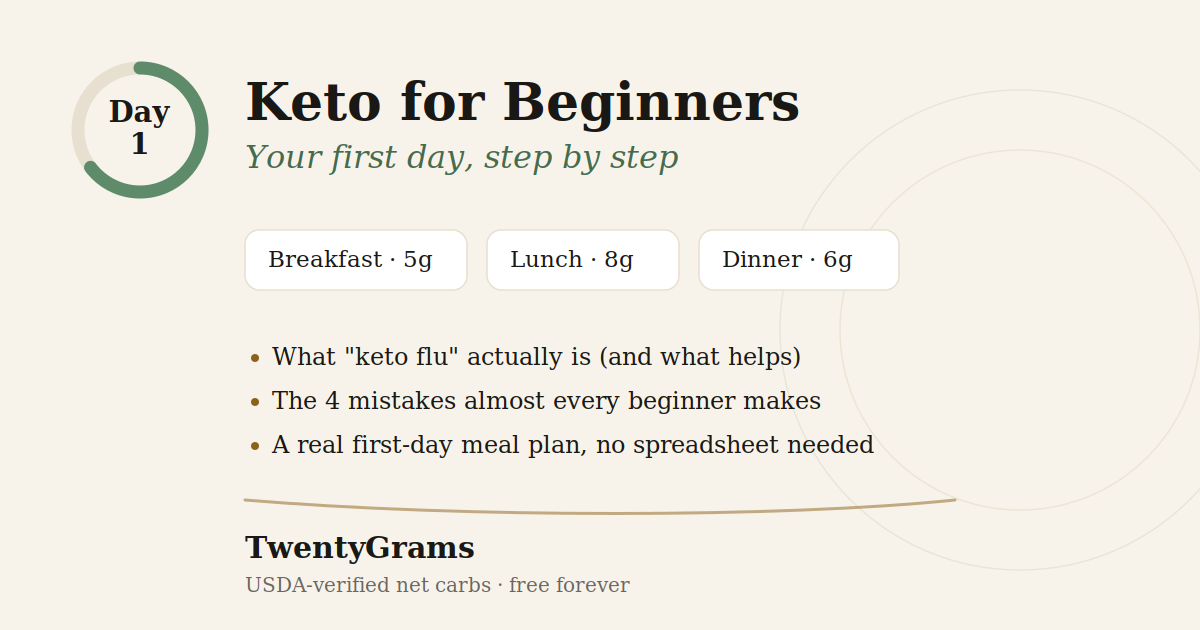
Most keto guides start with biochemistry. This one starts with your first day, because that’s the part nobody actually explains: what to put on your plate this morning, and what your body is likely to do about it. (This is one piece of our full keto for beginners guide — start there for the wider overview.)
What does “keto” actually mean?
Keep net carbs low enough — most people land somewhere under 20–30g a day — that your body shifts from burning glucose to burning fat for fuel. That’s the whole mechanism. Everything else is detail.
What should you eat on day one of keto?
You don’t need a meal plan spreadsheet for day one. You need three meals that don’t derail you. (Net carb figures below reflect typical USDA FoodData Central values for these foods in common preparations — exact numbers shift with brand, cut, and cooking method.)
Breakfast: Eggs are the easiest place to start — two whole eggs cooked any way is close to 1g net carbs. Add avocado (1g net carbs for half a medium one, per USDA FoodData Central — same figure as our net carbs quick-reference table) or a couple of strips of bacon and you have a full breakfast under 5g net carbs without thinking hard about it. One caveat worth checking: plain cured bacon is close to 0g carbs, but some cures add a sugar coating that bumps individual brands up slightly — the nutrition panel, not the category, is the source of truth.
Lunch: A big salad with a protein — chicken, salmon, or a hard-boiled egg — dressed with olive oil and vinegar. Leafy greens are almost carb-free; a cup of spinach is close to 0g net carbs. Skip the croutons and the sweet dressings, and lunch is usually under 8g net carbs. Dressing is the part people underestimate: a tablespoon of a bottled ranch or vinaigrette can carry 1–2g net carbs on its own, which adds up fast if you’re using several tablespoons — plain oil and vinegar sidesteps the question entirely.
Dinner: A protein plus a low-carb vegetable. Broccoli, cauliflower, asparagus, and zucchini all sit in the 2–6g net carb range per cup — a cup of cooked broccoli nets close to 6g per USDA data, cauliflower closer to 3g. (Both line up with the quick-reference table in net carbs, explained if you want to check other vegetables the same way.) A steak or piece of salmon with roasted broccoli is a complete, satisfying dinner well under 10g net carbs — pan-seared salmon with blistered asparagus is one worked example of that exact pairing, at 4.6g net carbs a serving.
Stack those three meals and a reasonable first day lands around 15–20g net carbs — without any specialty “keto” products.
What should you expect in the first few days of keto?
Some people feel fine immediately. A lot of people don’t, and this is worth knowing in advance rather than discovering it and assuming something’s wrong.
The common pattern — sometimes called “keto flu” — shows up as fatigue, headache, or brain fog in the first few days. It’s usually tied to water and electrolyte loss: when your body stops storing as much glycogen, it releases the water that was bound to it, and sodium, potassium, and magnesium go with it. This isn’t unique to keto specifically — any diet that meaningfully cuts carbohydrate intake can trigger a similar adjustment window. It’s a shift in water and mineral balance, not a sign that something’s gone wrong.
The general fix most people find helpful is simple: don’t restrict salt, drink water when thirsty, and lean on electrolyte-rich foods (leafy greens for magnesium and potassium, and salting your food more than usual). If you’re on medication or managing a health condition, this is a conversation for your doctor, not a blog post — bring your food log if you have one.
What mistakes trip up most beginners?
Not tracking fiber correctly. Total carbs and net carbs are different numbers, and mixing them up is the single most common beginner error — see net carbs, explained if you haven’t already.
Trusting “keto” packaging. A product labeled “keto-friendly” isn’t a guarantee — some are legitimately low-carb, others count sugar alcohols in ways that flatter the label. This is exactly the maltitol issue covered on the net carbs pillar page: some products subtract sugar alcohols from total carbs in full when the more conservative math says only partial credit is warranted, which makes the front-of-package “net carbs” number look better than the real one. Checking the actual nutrition panel — total carbs, fiber, and sugar alcohols listed separately — is still the reliable habit.
Going in with no plan for dining out or social meals. The first week is the hardest time to be caught without an answer for “what can you actually eat here.” Scanning a menu in advance for anything protein-and-vegetable-shaped removes most of the friction.
Weighing daily and reacting to normal water-weight swings. Early keto weight changes are mostly water, not fat, and they fluctuate day to day. Judging progress meal-by-meal or day-by-day means reacting to noise, not signal.
What’s the simplest way to get through day one?
None of this requires perfection. The formula is the same every meal: pick real food, keep the carb-heavy stuff out, and let the fiber math do its job. The part that actually trips people up isn’t the concept — it’s knowing, in the moment, whether what’s on your plate fits.
That’s the one thing TwentyGrams is built to do: type or search what you’re eating, and it tells you the real net carb number from the USDA database — no guessing, no manually subtracting fiber at the dinner table.
Once the basics are routine, the app you’re logging in starts to matter too — see switching keto tracker apps for what’s worth checking before you commit to one.