Is Banana Keto? Net Carbs, Ripeness, and What Actually Fits
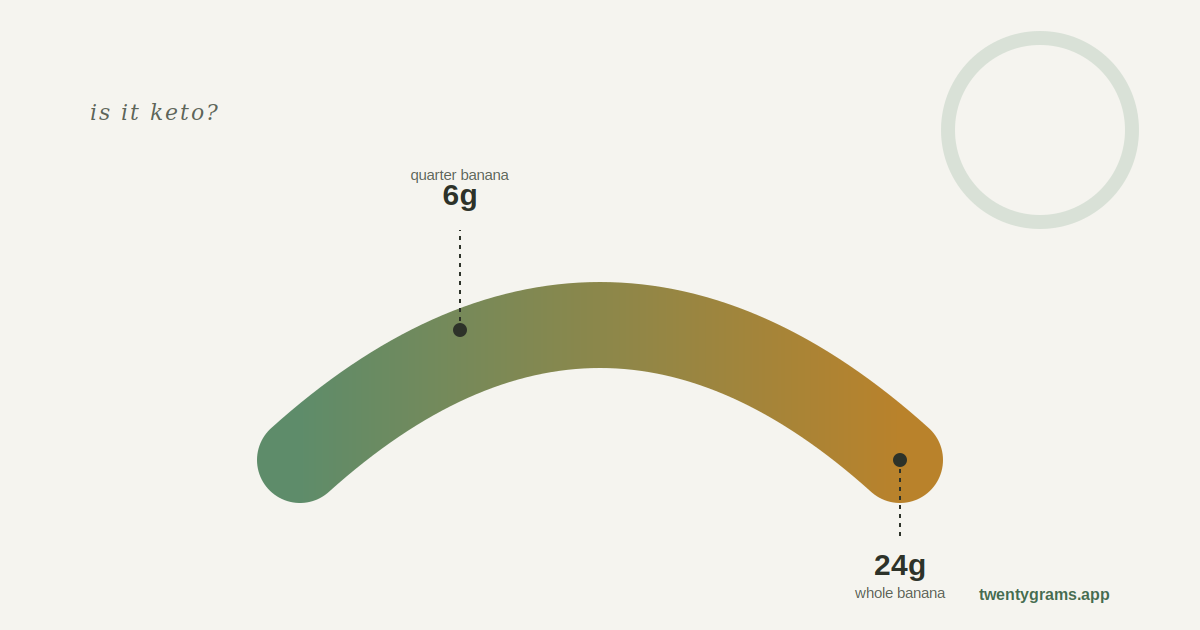
Short answer: a whole medium banana isn’t keto-friendly — it runs around 24g of net carbs on its own, which is most or all of a typical daily keto budget in one food. But “not keto” and “never fits” aren’t the same thing, and the ripeness question most articles skip is actually the more useful one.
How many net carbs are in a banana?
A medium banana (about 118g) runs roughly 27g total carbs and 3g fiber (closer to 3.1g in FDC’s raw banana entry), which nets out to around 24g net carbs, per USDA FoodData Central. That’s the number that matters for keto — total carbs minus fiber, not the total carbs on the label alone. (If the net-carbs formula itself is new to you, net carbs, explained covers the full breakdown.)
Size moves the number more than most people expect. Scaling that same per-100g ratio down to a small banana (under 7 inches, roughly 101g) puts net carbs closer to 20g; scaling up to a large banana (8–9 inches, roughly 136g) pushes it toward 28g. “A banana” isn’t one number — the one on the produce scale matters as much as the one on the nutrition label.
For context: most keto approaches target somewhere in the 20–25g net carb range for the entire day. One banana — especially a large one — can be the whole budget on its own.
Does banana ripeness change the carb count?
This is the part most “is banana keto” answers leave out, and it’s the most useful thing to know if you’re not ready to give bananas up entirely.
A green, unripe banana isn’t nutritionally the same food as a ripe yellow one. As a banana ripens, its starch converts to sugar — the greener the banana, the more of its carbohydrate is resistant starch rather than sugar. Resistant starch behaves more like fiber: it isn’t broken down and absorbed the same way, so it’s generally considered to have a smaller practical impact on blood sugar than the sugar in a fully ripe banana, even at a similar total-carb count on paper.
Worth being honest about the limit of this: USDA’s FoodData Central doesn’t carry a separate lab entry for “green banana” — its published numbers are for the standard raw banana entry, which skews toward the ripe, yellow fruit most people actually buy and eat. The resistant-starch effect is well-documented in nutrition science, but a lab total-carb assay on an unripe banana would likely still land close to the same total-carb figure — the difference is in how the body processes it, not necessarily in what a nutrition panel would say.
That doesn’t make a green banana “keto” — it still carries meaningful carbs — but it’s a real, measurable difference, not a diet myth. If banana is something you’re not willing to cut entirely, less-ripe is the more carb-conscious version of the same food.
How can banana fit into a low-carb day?
A few realistic options, roughly ordered by how much room they leave in a daily budget:
- A few thin slices, not a whole banana. A quarter of a medium banana is closer to 6g net carbs — small enough to fit as an add-on to something else, like a spoonful in a smoothie or a topping on Greek yogurt.
- Banana extract instead of the fruit. It carries the flavor without the carbs, and shows up in a lot of keto baking for exactly that reason.
- A lower-carb fruit swap. If what you actually want is “something sweet and fruity,” raspberries or strawberries deliver that at a fraction of the carb cost — a cup of raspberries nets around 7g compared to a whole banana’s 24g, per the same USDA data set. A cup of sliced strawberries runs in a similar range — high-fiber berries are consistently the lower-carb way to get a fruit fix.
None of these require guessing. The carb difference between a full banana, a quarter banana, and a raspberry swap is large enough that it’s worth knowing the actual number before deciding — not just going by feel.
What’s the practical takeaway?
If banana (or any high-carb food) is going to be part of your week sometimes, the useful habit isn’t avoidance — it’s knowing the real number before you eat it, so it’s a choice rather than a surprise later in the day. A quarter banana logged accurately costs you a lot less flexibility than a whole one logged as “a banana, roughly” — the gap between 6g and 24g net carbs is bigger than most people’s entire remaining carb budget for the day, and “roughly” is exactly the word that hides that gap.
That’s the specific problem TwentyGrams is built to solve: every food is matched against the USDA database, so a banana’s net carbs — or a quarter of one — comes from verified data, not an estimate. Log it by search or plain-text description, and the number is exact, not rounded in anyone’s favor.
If you’re building out a full day around foods like this, keto for beginners: your first day, step by step walks through a complete meal-by-meal budget.